Transfer Molding
Cleaner parting lines and controlled fill for insert-led parts and more complex geometry
Silicone Transfer Molding
Transfer molding loads compound into a transfer pot instead of the cavity. Once the mold closes, a plunger pushes material through the sprue and runner into the sealed cavity.
That sequence makes it useful when insert stability, cleaner parting lines, and more controlled fill matter more than the simplicity of standard compression.
- Compound enters after the cavity is closed and sealed
- Cleaner parting lines than compression on comparable geometry
- Metal inserts reviewed at DFM stage
- Tool choice confirmed against geometry, inserts, and finish requirements
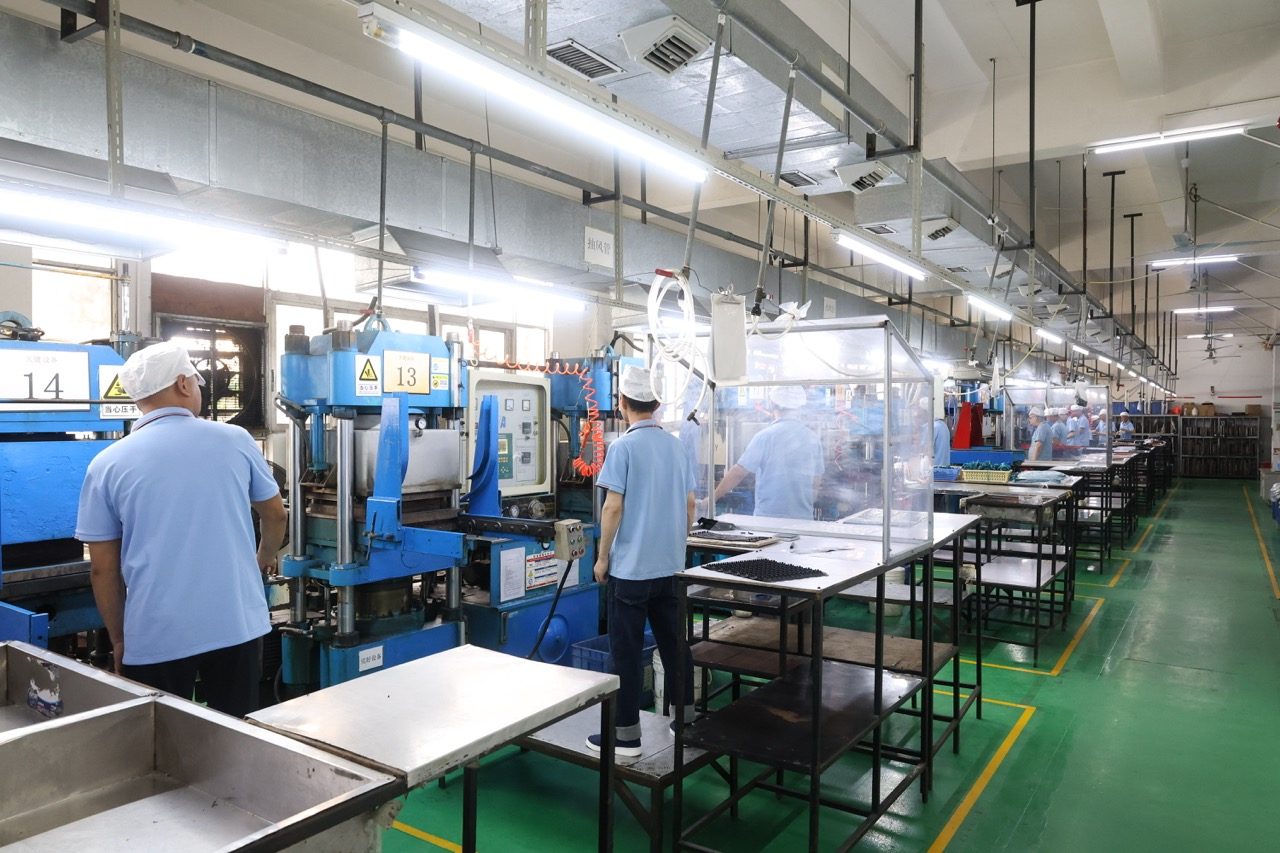
Transfer molding earns its place when control matters more than simplicity
This route sits between standard compression and LSR injection when the job needs better insert control, cleaner parting lines, and a more directed fill path.
That is why it remains the differentiator in this cluster rather than just another route page.
Insert integrity
Because the cavity closes around the insert before material enters, engineering can review insert location and fill direction together.
Parting line control
Sealing the cavity before fill usually produces cleaner parting lines than comparable compression tooling.
Controlled fill path
The transfer pot and runner system give a more directed fill path for parts with insert, geometry, or sealing-face constraints.
Transfer Molding Parameters
| Parameter | Detail |
|---|---|
| Compound Type | HTV Solid Silicone |
| Parting Line Performance | Tighter than compression on equivalent geometry |
| Primary Application | Metal-insert parts and more complex geometry |
| Insert Compatibility | Reviewed case by case at DFM stage |
| Hardness Range | 0–90 Shore A |
| Tolerance | Confirm at DFM review against geometry and critical features |
| Material Suppliers | Dow, Wacker ELASTOSIL, Shin-Etsu |
| Tooling Note | Dedicated transfer tooling required; existing compression tooling is reviewed separately |
Transfer Molding — Step by Step
Charge Loading
Pre-weighed compound goes into the transfer pot. Inserts are loaded where required.
Mold Close
The mold clamps and seals around the cavity before fill.
Transfer
A plunger pushes compound through the sprue and runner path selected during DFM.
Cure & Demold
The part cures under heat and pressure, then the sprue and runner are separated.
Inspection
Insert position, dimensions, and parting line quality are checked to drawing.
Best Suited For
- Metal-insert parts reviewed during DFM
- Complex geometries that need more controlled fill
- Sealing faces or appearance-sensitive parting lines
- Applications where flash reduction matters
- Precision control components with insert-related constraints
Not Suited For
- Very large flat parts where compression keeps tooling simpler
- LSR programmes that need dedicated injection equipment
- Ultra-high-volume runs where injection speed dominates
- Parts with no insert or parting-line constraint
- Very thin-wall structures better suited to LSR injection
Transfer Molding — FAQ
Request a Transfer Molding Review
Send drawings for DFM review when the part needs metal inserts, controlled fill, or cleaner parting lines.